
Business Acquisition · M&A
Where the First Crack Appears in a Downside Case
Before a buyer signs, the model should answer one question: where does the first crack appear if revenue lands 5% below plan? That is a more useful test than a broad downside label. A generic...
Before a buyer signs, the model should answer one question: where does the first crack appear if revenue lands 5% below plan?
That is a more useful test than a broad downside label. A generic “downside case” can make a model look disciplined while hiding the real issue: which assumption breaks first, and how quickly the pressure moves through the business.
At Riskova, we prefer a stress test that follows the actual drivers. Not because it is more elegant, but because it is more decision-relevant. If the model only shaves EBITDA at the end, it tells us very little about how the business behaves under strain.
Start with the drivers, not the conclusion
A practical downside case should run through revenue timing, gross margin, headcount, and working capital together. Those are the levers that determine whether the business can absorb a miss or whether the miss becomes a financing problem.
If revenue comes in 5% below plan, the question is not simply whether EBITDA declines. The question is whether the business can still fund payroll, debt service, and inventory without relying on a price cut or extra equity. That is the level at which a model becomes useful to a buyer.
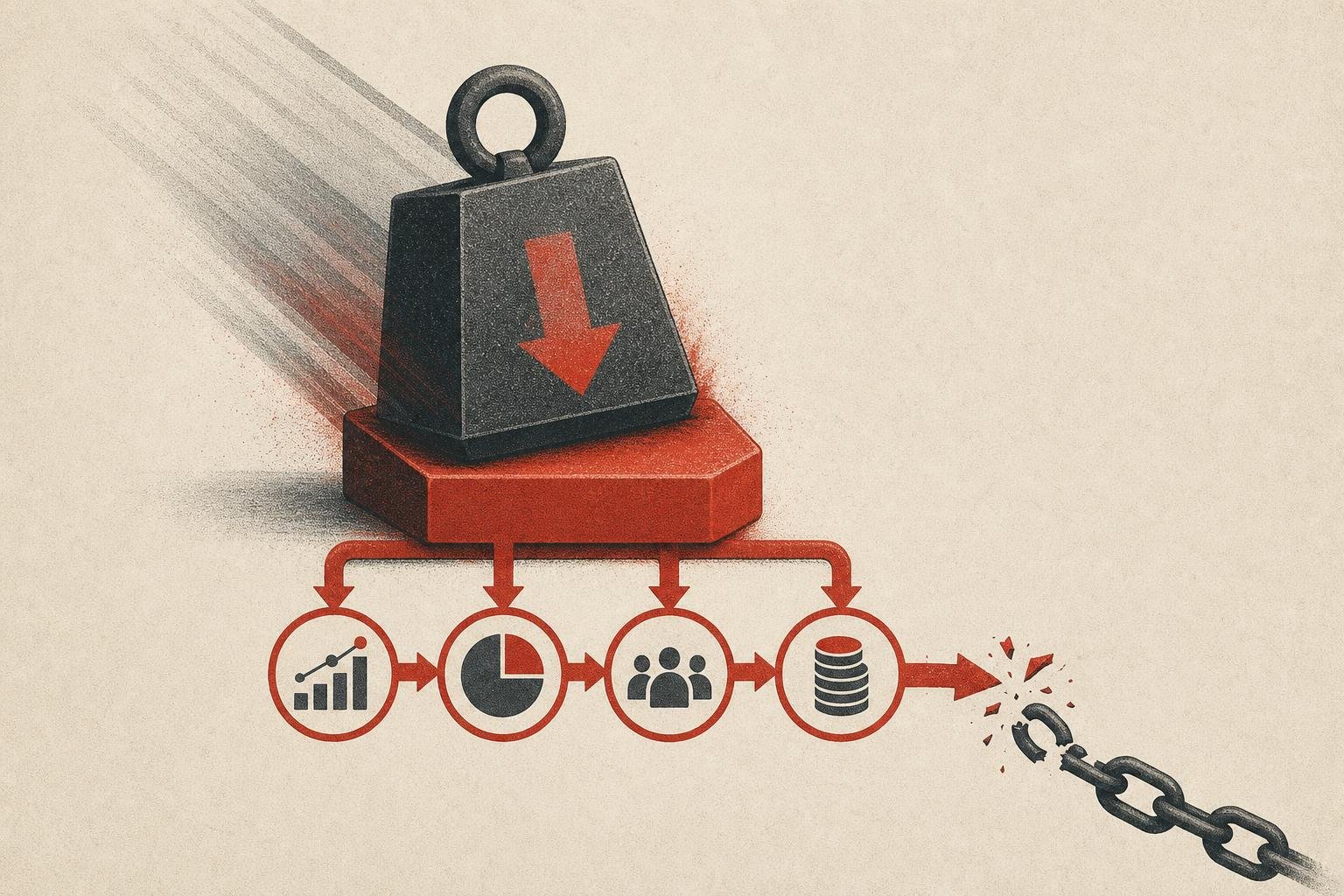
When the downside is built properly, the result is rarely a single number. It is a sequence. Revenue slips, collections slow, cash tightens, and optionality narrows. The model should show where that sequence begins.
Find the point where the model stops supporting itself
The most important output is often the first assumption that no longer holds. That may be pricing, debt capacity, or covenant headroom. Once one of those becomes fragile, the transaction profile changes.
This is why we look for the point where the model stops being self-supporting. At that point, the buyer is no longer reviewing a resilient operating case. The buyer is reviewing a structure that depends on either better-than-planned performance or additional support.
That distinction matters in private equity and in broader M&A. A business can still show positive EBITDA while quietly losing the ability to carry its own working capital needs. It can still look acceptable on a summary page while the operating mechanics are already under pressure.
Stress-testing is a decision tool
Stress-testing is not about proving the deal works. It is about finding the assumption that does not. That is the discipline buyers need before signing, especially when the model is being used to support price, leverage, and structure.
For associates, that means tracing the downside through the model instead of accepting a shorthand label. For directors, it means asking whether the case reveals a real break point or just a cosmetic haircut. For buyers, it means understanding how much room exists between plan and fragility.
At Riskova, we treat that work as part of underwriting discipline. The goal is not to make the model look conservative. The goal is to make the first crack visible before the deal is signed.